Empowering Women Is Key to ending HIV/Aids- ED Swid .
By Samuel Mwesigwa .
As Uganda marks World AIDS Day at the national celebrations hosted in Bushenyi District, the Slum Women Initiatives for Development (SWID) has warned that poverty remains the single biggest driver of HIV/AIDS transmission, particularly among women and young girls across the Busoga region.
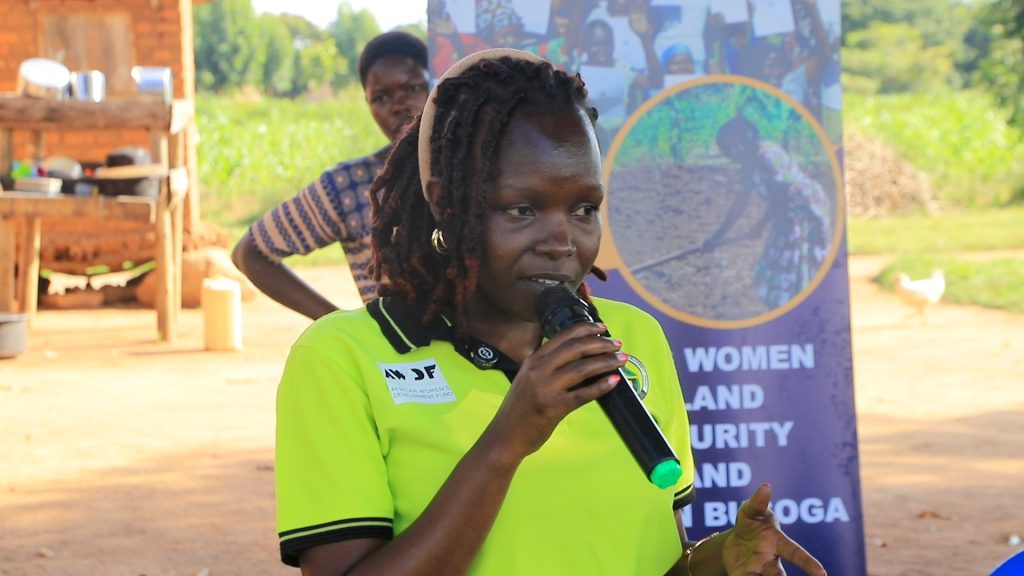
Speaking during community outreach activities, SWID Executive Director Ms. Doreen Kaira King said economic vulnerability continues to trap many women and girls in unsafe, exploitative relationships as they struggle to meet basic survival needs such as food, shelter, school fees, and startup capital for small businesses.
“In communities where we work, poverty exposes women and girls to abuse and exploitation,” she said. “When survival replaces choice, dignity and health are easily sacrificed. Empowering women is not charity — it is prevention.”
Tragic Stories from Community Outreach
While in our community outreach, we met two young mothers with heartbreaking stories that reflect the reality faced by thousands of women and girls in poverty-stricken communities where SWID operates.
Sarah — Childhood Stolen by Survival
In Kaliro District, we met Sarah, 20, already a mother of three children — each with a different father.
Her suffering began after her father died during the COVID-19 pandemic in 2021, leaving a family of seven children under the care of a struggling single mother living in a rented mud-and-wattle house. With no stable income, school fees went unpaid, food became scarce, and rent arrears accumulated.
The landlord reportedly demanded Sarah as “security” for unpaid rent, leading to her first pregnancy.
Later, as Sarah pleaded to remain enrolled in a private secondary school without paying tuition, she says she was exploited by the school director — who demanded sexual relations in exchange for tuition — resulting in her second child.
Upon returning to the local market area, Sarah became a victim of a gang rape by unknown men, leading to her third pregnancy. She does not know who fathered her youngest child.
Although Sarah has not contracted HIV, at only 20 years old she now bears the lifelong responsibility of raising three children — her education cut short and her childhood lost to survival struggles.
Scovia — Poverty Became a Pathway to HIV
In the island communities of Namyingo District, we encountered Scovia, 32, a single mother now living with HIV/AIDS.
She told us that she borrowed money to start a small trading business. When she failed to repay the loan on time, the lender allegedly demanded sex as payment — despite knowing he was HIV-positive.
With children to support and nowhere else to turn, Scovia felt trapped.
That single act of desperation permanently altered her life.
The hidden Crisis
Nationally, an estimated 1.5 million Ugandans are living with HIV, with adult prevalence standing at approximately 4.9%. In the Busoga sub-region, prevalence averages around 3.3%, though some urban areas report rates close to 6%, indicating persistent vulnerability driven by economic hardship.
“These numbers hide real pain,” Ms. Doreen Kaira King said. “Behind every statistic is a woman or a girl whose reality is shaped more by poverty than by choice.”
Empowerment as Prevention
SWID currently supports over 500 women across Busoga through programmes focused on:
Entrepreneurship and business-skills training, Value-addition initiatives, Financial literacy education, Life-skills and confidence building
Women who gain stable incomes are significantly less likely to be drawn into survival-based relationships that heighten HIV risk.
SWID estimates that scaling these initiatives to reach up to one million women across Busoga could produce a ripple effect capable of:
Reducing new HIV infections among women and adolescent girls. Breaking dependency on exploitative transactional relationships Strengthening household economic stability
Accelerating national progress toward HIV prevention targets
However, SWID emphasizes that achieving this scale requires increased government investment and strengthened partnerships with grassroots organisations.
Appeal to Parents and Communities
The organisation also called for renewed parent–child dialogue, warning that many adolescents fall into high-risk relationships due to poverty, peer pressure, emotional neglect, and lack of guidance.
“Parents are the first protectors,” Ms. Kaira King stressed. “Open conversations at home save lives.”
Poverty — The Silent Epidemic
As Uganda commemorates World AIDS Day — with the national event taking place in Bushenyi District — the experiences of Sarah and Scovia stand as powerful reminders that HIV’s roots run far deeper than biology.
Where poverty removes choice, HIV finds space.
Empower women, protect communities, and Uganda can end AIDS.
Ending HIV will require more than medical treatment — it demands economic justice, strong social protection, dignity for women, and sustained empowerment efforts.
Empower women. Protect families. End AIDS.
